
Calhoun County Deed Records by Instrument
The County Clerk is the recorder for Calhoun County. Every deed names a grantor and a grantee. The grantor gives the interest; the grantee takes it. A deed may convey land, reserve a right, correct an earlier description, or move property through an estate. Deed records are only part of the land file, since a deed of trust, release, lien, easement, or plat can sit nearby without being a sale.
| Deed Type | What It Does | Common Use |
|---|---|---|
| Warranty deed | Conveys the interest described and includes the promises stated in the deed | Reviewing a purchase transfer |
| Quitclaim deed | Transfers whatever interest the signer has, if any | Family transfers or a title correction |
| Executor or administrator deed | Shows an estate fiduciary conveying land | Following a probate transfer |
| Trustee or sheriff deed | Records a transfer after a court or sale process | Checking a foreclosure or tax-sale trail |
| Deed of trust | Creates a security interest, rather than a land sale | Reading mortgage and release history |
A deed records a conveyance. A mortgage only secures debt. A release or satisfaction can later discharge that interest, so read the instrument type and legal description before treating an index hit as an ownership change.
Calhoun County's Two Online Deed Eras
Calhoun County deed searching splits into two eras. The Self-Service Portal holds official records from 1992 on. Historic indexes live separately on Kofile. There, deeds run from 1845 to 1985, and deeds of trust from 1911 to 1985. Those dates describe index coverage, not a promise that every image is online.
Match the system to the instrument's date. Then compare party names and the legal description against the Assessor card. The modern portal may hold an image. An older index may show only a reference you must take to the Clerk for a copy. For an uncertain year, ask the office which index covers it before repeating searches in the wrong place.
One page gathers the routes. The County Clerk's online records hub links the modern search, the historic index, the Laserfiche plat collection, court records, and Fraud Notify. Opening it first saves dead ends.
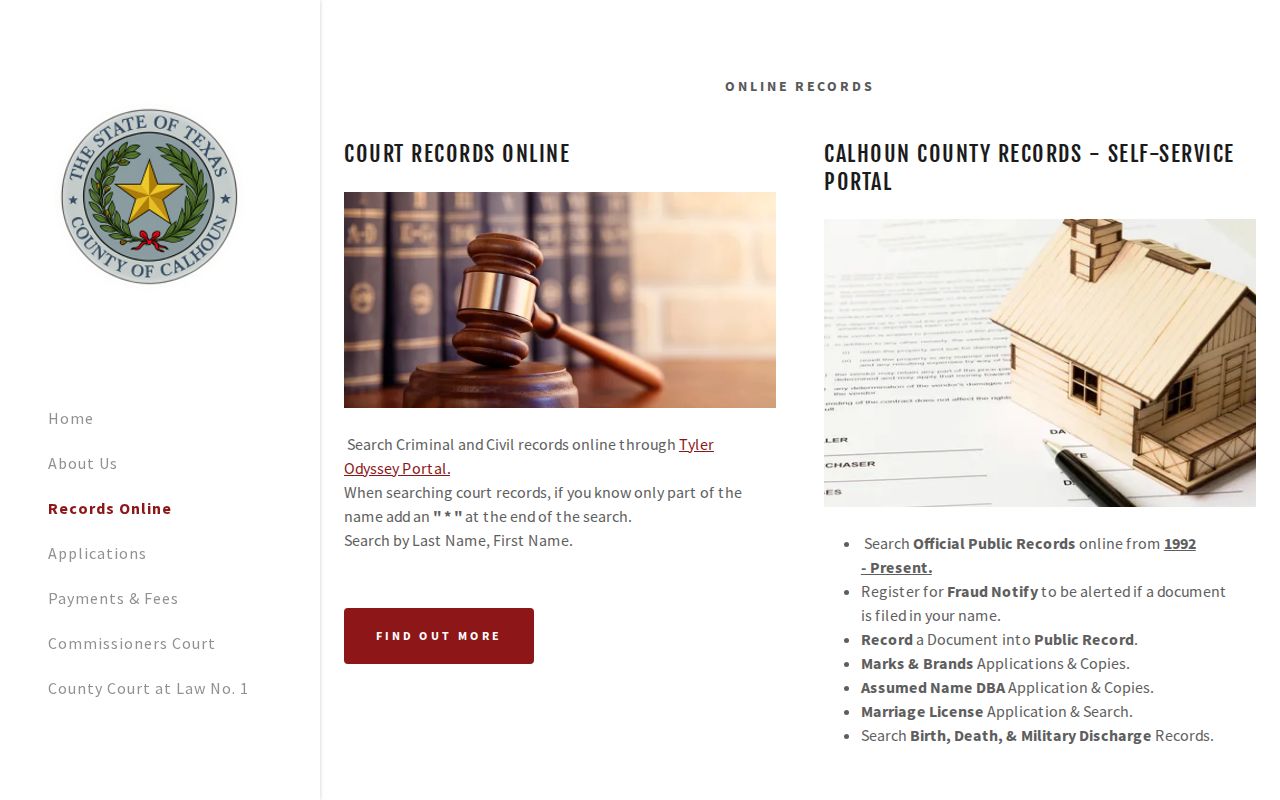
Start recent searches in Self-Service, older ones in Kofile.
Following Calhoun County Grantors and Grantees
Every deed has two parties. The grantee takes it; the grantor gives it. Start the chain at the newest deed. Record its grantee, grantor, date, book and page, and legal description before moving backward. Search each prior owner as a grantee in the earlier period, then repeat the process with that deed's grantor. A line for every instrument keeps gaps and name changes in plain view.
- Use the Assessor owner or legal description to identify a likely current deed.
- Record both parties, the instrument type, filing date, book/page, and property description.
- Search the grantor as an earlier grantee and compare the described land with the current tract.
- At the index limit, move to historic books or ask the Clerk which earlier record source applies.
- Grantor
- The party transferring an interest.
- Grantee
- The party receiving an interest.
- Chain of title
- The ordered trail of recorded conveyances for the described property.
- Book and page
- A volume and page reference used to locate a recorded instrument.
- Index entry
- A finding aid; the filed deed must be read to understand its terms.
Calhoun County Recorder Search Controls
Search controls differ across the Clerk's systems. The main portal handles modern records, while a separate court portal offers Last Name and First Name fields. A trailing asterisk widens a partial name. Laserfiche uses Browse and a search bar for plats and Commissioner's Court records. These are separate systems. A court-party search will never double as a deed search, and the Clerk's page publishes no complete field list.
| Control | System | Use or Limit |
|---|---|---|
| Official records search | Self-Service | Modern public records advertised from 1992 forward |
| Kofile index books | Historic indexes | Separate deed and deed-of-trust series; use the right year range |
| Browse, County Clerk | Laserfiche | Opens plat and Commissioner's Court collections |
| Last Name / First Name | Tyler Odyssey | Court party search; trailing * permits a partial name |
| Fraud Notify | Clerk records page | Alerts when a document is filed in a subscribed name; terms are not documented |
Laserfiche sometimes opens with a prefilled cookie message. The Clerk's page says Sign Out clears it. Expect an image gate inside the portal, and treat copy fees and image availability as questions for the Clerk rather than promises of free access.
Plats and Calhoun County Legal Descriptions
A legal description beats a street label. Town lots use lot and block language tied to a plat. Rural deeds run metes and bounds. Those calls lean on distances, monuments, streams, ridges, adjoining owners, and acreage. A replat can change a label, but it never erases an older deed's easement or reservation. Compare every call instead of trusting a subdivision name.
Plats live with the Clerk too. The office links an Index to Map and Plat Record 1 PDF plus a Laserfiche portal for plats and Commissioner's Court records. In Laserfiche, choose Browse, then County Clerk. That route works when the login message blocks the collection. The county GIS shows the parcel visually, but the recorded plat and deed carry the legal description. A boundary dispute calls for a licensed surveyor.
For map layers and single-parcel views, the county's parcel maps reference covers that side, while this section stays with the filed text.
Calhoun County Fraud Notify and Liens
The Clerk offers a service called Fraud Notify that alerts a subscriber whenever a document is filed in that subscribed name. The public page does not list its cost, coverage, or delivery method. An alert has limits. It cannot stop a filing. It never replaces reading the deed itself. Treat each notice as a starting point, then match the reported instrument to the County Clerk's index and the parcel description in the property records.
A deed of trust or mortgage is an encumbrance, not a deed sale, so follow releases, assignments, judgments, easements, and liens as their own instruments. UCC filings sit outside the deed records. That state-level system covers personal-property collateral. It may mention fixtures, yet proves no real-estate lien. Check the collateral, then search the County Clerk's real-property records for the lien itself.
Foreclosure and delinquency paperwork scatters. The court case, the Sheriff's tax record, the redemption file, and the final deed may sit in different offices. Work through the complaint, lis pendens, judgment, sale order, confirmation, and recorded conveyance as distinct steps, since a tax sale is an administrative collection path rather than an automatic mortgage foreclosure.
Calhoun County Deeds Before 1856
Calhoun County split from Gilmer County in 1856. The Clerk's deed indexes begin in 1845, so an older chain may cross the county line in time. Note the jurisdiction at every link. Record the office that held it when signed. A historic Gilmer deed can describe the same land now sitting under a Calhoun account or map number.
Grantsville adds another marker for early parcels. Simon P. Stump platted the town in 1866. The county seat moved there in 1869. For an early town lot, search the Map and Plat record and later deed language for lot, block, road, and easement details, since a modern address may never appear in the historic book.
The Library and the Historical and Genealogical Society hold cemetery records, family books, church histories, microfilm, and local histories. These can surface an older household or a spelling variant. A family history is only a lead, not proof of the transfer. Only the recorded deed, probate order, or court instrument establishes the transfer.
Requesting a Calhoun County Deed Copy
When the portal returns an index hit but no usable image, reach out to the County Clerk with the party names, the recording date, the book and page or instrument number, and the legal description. Ask if the document can be inspected, whether a plain or certified copy is available, how to pay, and whether it can be mailed. The public page posts no current copy schedule. Assume no fee until the office states one.
The Clerk's office is at P.O. Box 230, Grantsville, WV 26147, phone 304-354-6725, email calhounclerk@gmail.com. Counter hours are not listed online. Call first, especially for an older book, an archived case, or a plat kept outside the modern portal.
A focused written request under West Virginia's Freedom of Information Act, W.Va. Code Chapter 29B, should describe one specific record. The custodian must respond as soon as practicable and within five days, excluding weekends and legal holidays. Actual reproduction cost may be charged; search labor may not. That is a response rule, not a promise that a large retrieval is complete within five days.
Recorded, not guaranteed. The Calhoun County deed index shows what the system indexes, not every private claim or unrecorded interest. Read the instrument and seek a title review for a full ownership opinion.