
What Calhoun County Property Tax Records Show
Two county offices split the tax record between them. The Assessor keeps the property card, the classification, any exemptions, and the annual assessment. The Sheriff acts as county treasurer and collects state, county, municipal, and school taxes. Because the tax portal demands a roll type and year, read every bill with its period in mind. The assessed number is not a recent sale price. The bill is not a deed history either.
| Field | What It Shows | Where |
|---|---|---|
| Assessed value and class | Tax basis and property class; the Assessor assesses at 60% of market or appraised value | Assessor |
| Exemption or farm-use status | May reduce the taxable base or use a different valuation method | Assessor |
| Tax bill number | Identifies a bill within the selected roll and year | Sheriff / Treasurer |
| Payment or delinquency | Shows the tax account status for the selected period | Sheriff / Treasurer |
| Taxing bodies | State, county, municipal, and school taxes are collected | Sheriff / Treasurer |
Assessment, taxable value, and sale consideration are related but far from identical. A property's class and its exemptions shape the figure the tax is built on, while a deed records the transaction itself and its terms. For a fuller explanation of how these numbers differ from a market estimate, see the Calhoun County property value reference.
Calhoun County Tax Search Steps
The tax application works from one search mode plus a roll type and a year. Choose a mode first. The year matters because each assessment reflects an earlier July 1 snapshot of the parcel. If an address search comes up empty, copy the property number straight from the Assessor card or the bill. Do not guess at its segments.
Looking Up a Calhoun County Tax Bill
Start with whatever location or property clue you hold. Then set the Sheriff portal's roll and year controls. The interface offers owner, location, property number, and tax-bill number as separate modes. Use only one at a time. For an owner, last name first is the preferred format. The instructions suggest the last name alone. For a location, the street name works best. The portal will not combine that option with an all-years view.
- Open the Calhoun tax search and choose the roll type and tax year first.
- Enter one key: owner, street location, property number, or bill number.
- Read the matching bill and status for that year, then keep its property number.
- Check the Assessor card for classification and exemption details, and contact the Sheriff about payment or delinquency.
- Assessed value
- The figure used for tax purposes under the applicable assessment rules.
- Levy
- The tax charge adopted by the taxing bodies and applied to taxable value.
- Homestead exemption
- A qualifying reduction from assessed homestead value; it is not proof of occupancy.
- Delinquency
- Unpaid tax status that can lead to notices and later collection steps.
Calhoun County Assessment Calendar
The Assessor pegs every assessment to July 1. Tax books for a calendar year capture ownership, taxability, condition, and use. All of it reflects the prior July 1. The land and personal-property books close by January 30. They move to the Board of Review and Equalization by February 1. Assessed values are certified by March 3. A deed filed after the July snapshot may not match the owner name on the next tax roll. That timeline explains it. For a recent transfer, line up the deed recording date, the tax year, and the assessment date. Then ask the Assessor whether the change has reached the current roll.
Assessment generally sits at 60 percent of market or appraised value. Class II covers owner-occupied residential and farm property. Class III is other taxable property outside an incorporated municipality. Class IV is other taxable property inside one. Calhoun has a single incorporated town. So whether a parcel lies inside Grantsville can change its class and levy treatment. The class is not an occupancy record.
Calhoun County Exemptions and Farm Use
West Virginia offers a $20,000 homestead exemption from assessed homestead value. It applies to a resident who has been, or will be, a resident for two consecutive years before the tax year. The resident must also be at least 65 or totally and permanently disabled. Applications go through the Assessor's office from July 1 through December 1. Anyone who turns 64 by the July 1 assessment date should apply. Apply for the next tax year.
Farm-use valuation is a separate track. Approved farmland is appaised on fair rental value. The Assessor notes this may run one tenth or less of market value. Owners apply from July 1 through September 1 unless the form arrives by mail. Managed timberland and other preferential treatments can also skew the comparison. Ask the Assessor which program applies to a given card rather than inferring market value from the tax figure.
Mobile homes or buildings sitting on someone else's land may be taxed as personal property. A building can then appear in a tax file with no matching land owner. Use the land description and the deed. They separate ownership of the structure from ownership of the parcel.
Calhoun County Tax Search Fields
The tax portal keeps its search options deliberately distinct. Its form advises one option paired with a roll type and year. Its location search carries a special limit. A tax bill number is not the Assessor's account. Even when both point to a single parcel. Keep the field label and the year with any result you save.
| Search Mode | Input | Portal Note |
|---|---|---|
| Owner | Name | Last name first; last name alone is recommended |
| Location | House number and street | Street name alone is recommended; “all years” is not allowed |
| Property number | Full or partial displayed number | Copy the grouped format from a tax record |
| Tax bill number | Bill identifier | Use with roll type and tax year |
Open the Calhoun County tax search to see the live controls. The page displays the separate modes and year selectors, not a sample of any parcel's balance or payment record.
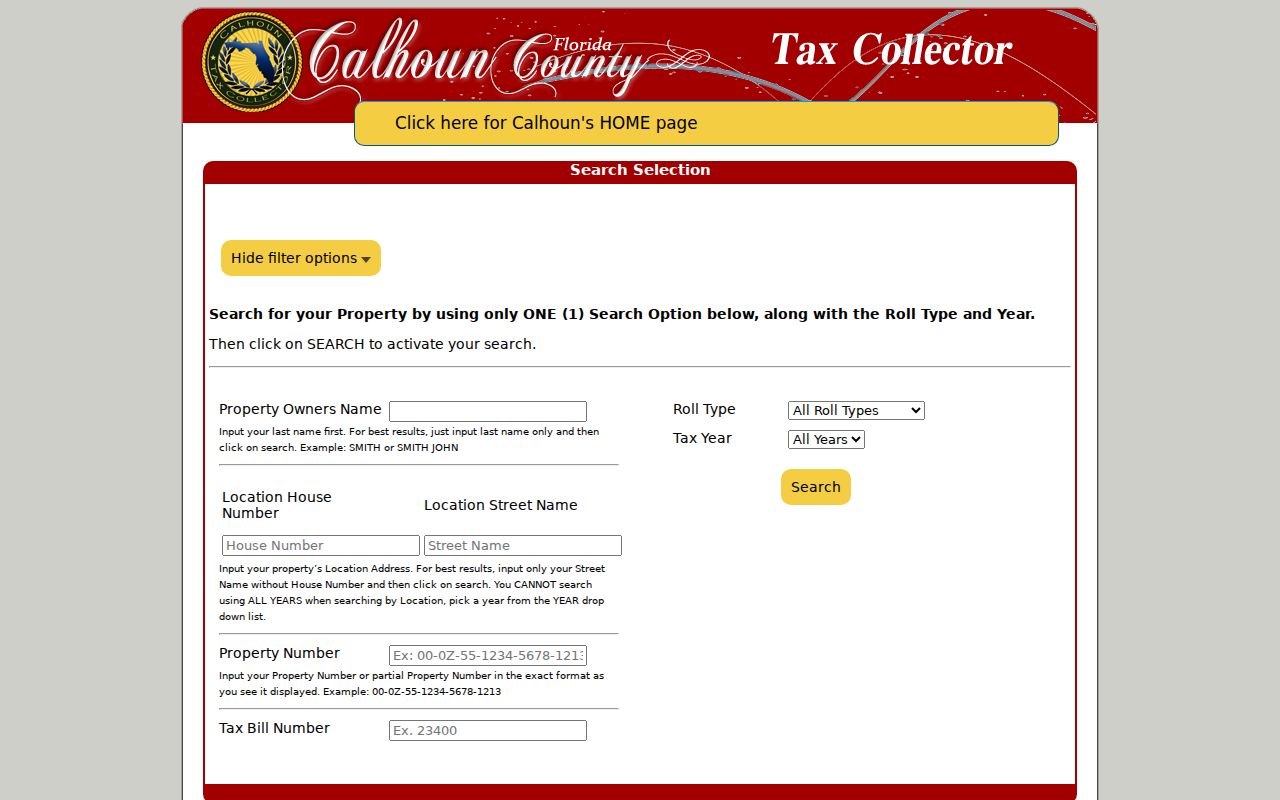
Pick the tax year and roll type that match what you need before you run a Calhoun County property tax lookup. Matching the year and roll to the Assessor's figures keeps the comparison honest. Otherwise the numbers can look wrong when they are simply from different cycles.

Keep office contact details apart from any single tax account result, and confirm payment status with the Sheriff.
Calhoun County Tax Appeals
The Assessor sets both value and classification. Objections go to the Board of Review and Equalization, which meets in February. The County Commission itself sits as that board. Start with the Assessor's card. Pull the parcel details and any comparable evidence. Then ask the county for the current notice, calendar, hearing location, and delivery rules. Calhoun County publishes no stated annual notice date or filing deadline. Get the dates from the office directly.
The state petition asks what steps the owner took first. It includes a checkbox for appearing before the county board in February. The Tax Division form link is currently broken. Obtain the current version from the state Tax Division or the county office before filing. An old form can sink a timely appeal. Delivery method matters too.
For state guidance, start at the West Virginia Tax Appeals site. Verify the current form and instructions there. A timely county review comes first in the documented process.
Appeal timing. Calhoun County's review board meets in February. Confirm the current notice and filing deadline with the Assessor or Commission before sending an appeal.
Delinquent Calhoun County Taxes
The Sheriff collects taxes and enforces delinquent ones. The County Clerk handles redemption notices and delinquent-property deeds. Each document tells a different part of the story. A delinquent bill, a tax-sale publication, a redemption notice, and a later deed are separate records. Calhoun County offers no current delinquent-list download, calendar, purchaser requirements, or redemption fee schedule online. Ask the offices for those.
Ask the Sheriff about the tax year, roll, bill, payment status, and any public sale notice. Ask the Clerk whether a redemption notice, court order, or deed was recorded. A delinquency is an administrative collection process, not automatically a mortgage foreclosure. A court action may be involved. The Circuit Clerk's Odyssey search and file copies offer another route.
West Virginia's Freedom of Information Act is W.Va. Code Chapter 29B. It supports a focused request for a defined tax-year entry or the published delinquent real-estate list. A custodian must respond within five days excluding weekends and legal holidays. That window does not guarantee completion of a large archive search. Reproduction cost may be charged. Search labor may not.
Appealing a Calhoun County Assessment
Start with the Assessor's parcel card. Identify the value, classification, and tax year you want reviewed. Gather focused evidence aimed at the disputed item. This could be the deeded legal description, a recorded transfer, property characteristics, or relevant comparable information. The County Commission sits as the Board of Review and Equalization. It hears assessment objections in February. Ask the Assessor or Commission for the current notice, meeting schedule, submission method, and deadline. Calhoun County states no annual filing cutoff in its local sources.
Appeal timing. The land books are completed by January 30 and go to the Board of Review and Equalization by February 1; the Board meets in February and values are certified by March 3. These dates do not establish a filing deadline. Confirm the current schedule and delivery rules with the county before submitting an objection.